Powerplant
The engine drives the main rotor and tail rotor through the transmission. Two families dominate civilian helicopter aviation: piston (reciprocating) engines on most training helicopters, and turbine engines on commercial and military aircraft. Each has distinct operational characteristics, failure modes, and pre-flight checks. The system you fly determines what you watch for during start, climb, cruise, and shutdown.
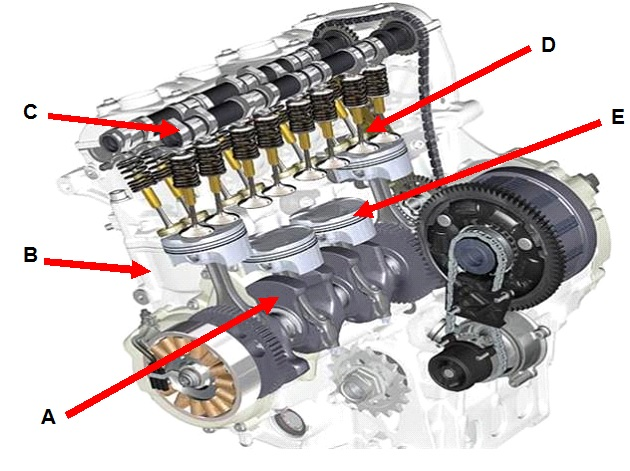
Piston (Reciprocating) Engines
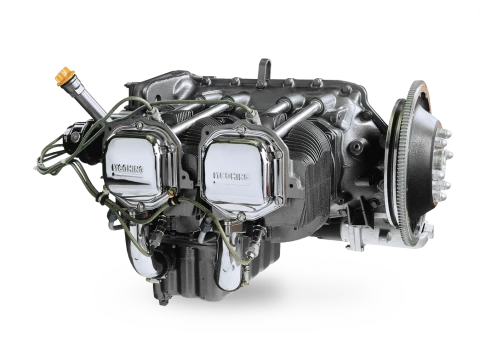
Common in training aircraft: Robinson R22/R44 (Lycoming O-320/O-540), Cabri G2 (Lycoming O-360), Schweizer 300 (Lycoming HIO-360). All horizontally opposed, four or six cylinders, air-cooled, direct-drive.
Carbureted vs fuel-injected:
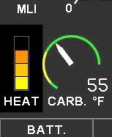
- Carbureted (R22, Cabri G2): cheaper, simpler, prone to carburetor ice. Most engine failures in training helicopters trace back to carb ice. Apply carb heat per POH — typically anytime power is below cruise setting and OAT/dewpoint conditions favor icing. The cockpit carb heat indicator shows when ice formation is likely (yellow/orange band on the gauge below).
- Fuel-injected (some R44s, R66): more efficient, no carb ice, but more complex — prone to vapor lock on hot starts. Different start procedure than cold start.
Mixture management: Lean as altitude rises (DA above ~3,000 ft) to maintain peak EGT and prevent fouling. Most piston-engine failures during high-DA flight involve unleaned mixture and fouled plugs.
Turbine Engines
Common in commercial/EMS/military: Bell 206 (Allison/Rolls 250), Airbus H125 (Arriel), Bell 407 (Rolls 250-C47B). Free-turbine designs dominate — a gas-producer turbine drives a separate power turbine that drives the rotor.
Strengths: Higher power-to-weight ratio. Less maintenance per hour. Better high-altitude performance (less density-altitude penalty than piston). No carb ice, no mixture leaning.
Weaknesses: Hot starts can damage the engine within seconds — strict start sequence and TGT (turbine gas temperature) monitoring required. Compressor stalls, FOD ingestion, and hot-section limits are operational concerns piston pilots don't face.
Lead-time: Turbine response is slower than piston — when you need power, it takes 1-2 seconds for the gas producer to spool up and deliver more torque. Anticipate; don't react.
Engine instruments to watch
- Manifold pressure (piston) / Torque (turbine) — primary engine power indicator. Stays in the green during normal operations.
- Tachometer — engine RPM (Np) and rotor RPM (Nr). The rotor RPM is the critical one. Don't let it droop into the yellow.
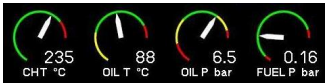
- Oil temperature and pressure — continuous monitoring. Anything outside the green is a land-as-soon-as-practical signal.
- Cylinder head temperature (piston only) — stays below redline. Cruise climb if CHT is climbing.
- Turbine gas temperature (turbine only) — hot-section life is a function of TGT exposure. Brief excursions cost engine cycles.
- Fuel flow / fuel pressure — verify expected burn rate vs flight time.
Pre-flight powerplant checks
- Cowl/inspection panel — secure, no oil leaks, no soot patterns indicating exhaust issues.
- Oil quantity — within range. Check during preflight, not after engine has been running.
- Fuel system — sumps drained, water-free, correct fuel grade.
- Spark plugs (piston) — visual check for fouling.
- Air filter — clean, no obstructions.
- Run-up checks — magneto drop within limits (piston), engine and rotor instruments stable.