Flight Instruments
The PPL pilot needs to know what each cockpit instrument is telling them, what its limits mean, and what to do when it disagrees with reality. The IFR pilot will study all of these in much greater depth — see IFR Instruments for systems-level coverage. Here we focus on the operational basics: airspeed, altimeter, VSI, tachometer, manifold pressure / torque, and engine indications.
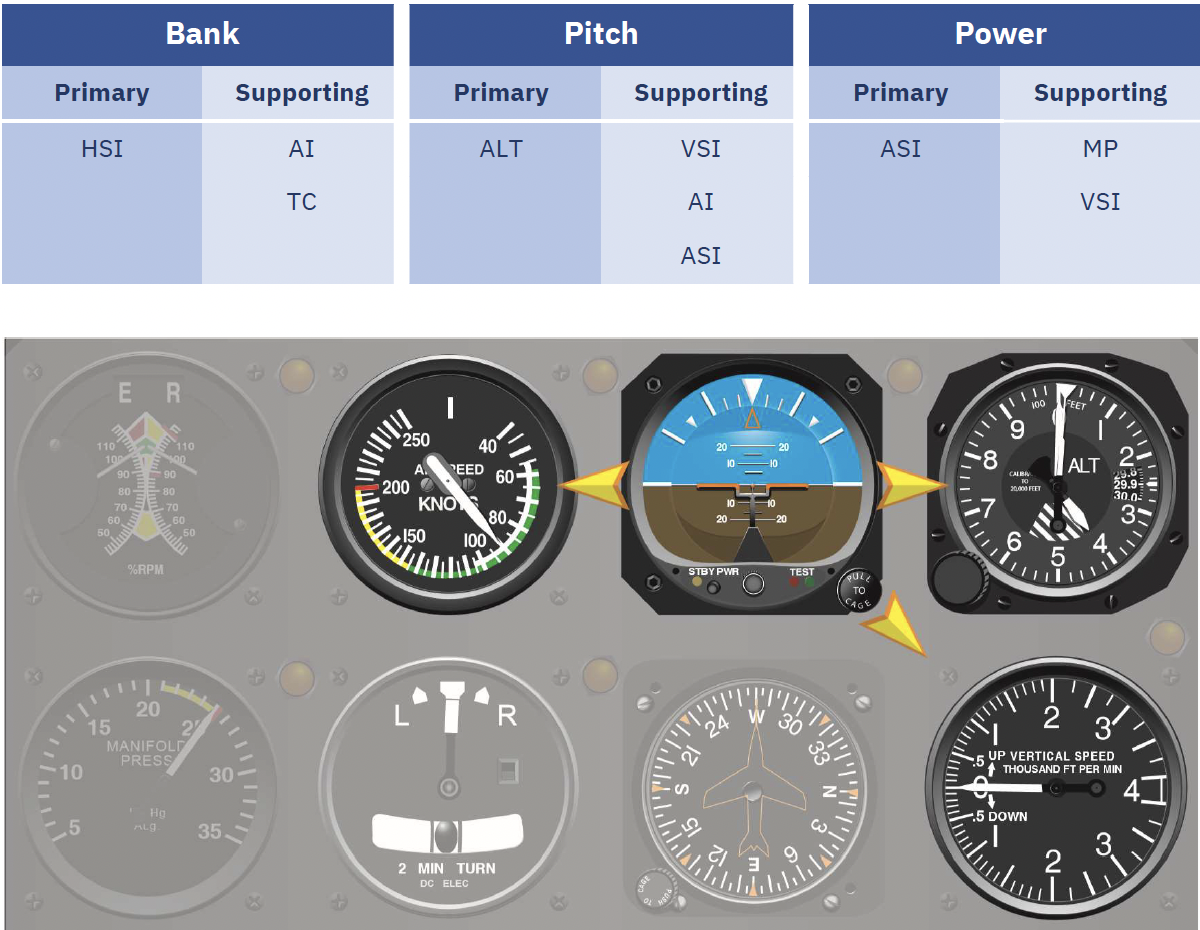
Airspeed Indicator (ASI)
Pitot-static system. Differential pressure between ram-air pitot and ambient static produces airspeed reading.
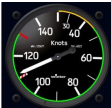
- Reads indicated airspeed (IAS) — uncorrected.
- True airspeed (TAS) is higher at altitude due to lower air density. Standard rule: add ~2% per 1,000 ft.
- VNE — never-exceed speed. Red line.
- VY — best rate of climb. Memorize for your aircraft.
- VA (less applicable to helicopters than fixed-wing) — maneuvering speed.
Common failure: pitot tube blocked. Reads erratically or freezes. Pitot heat (if equipped) prevents the most common cause (icing).
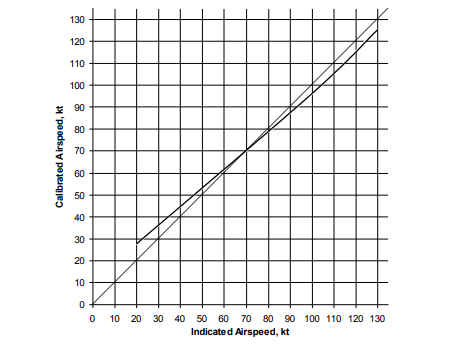
Altimeter
Static port reading. Aneroid wafers expand or contract with pressure changes; mechanical linkage drives the needles.
- Set altimeter to current local pressure (Kollsman window) per ATIS, ASOS, or ATC. "Altimeter setting" expressed in inches of mercury (29.92 standard).
- 1 inch of Hg ≈ 1,000 ft. So an altimeter setting that's off by 0.1 in Hg corresponds to ~100 ft of altimeter error.
- MSL altitude — feet above mean sea level (what the altimeter normally reads).
- Pressure altitude — what it reads with 29.92 set.
- AGL altitude — feet above ground level. Not directly displayed; you compute it.
Common failure: static port blocked. Altimeter freezes at the altitude where blockage occurred. Alternate static source (where equipped) provides backup.
Vertical Speed Indicator (VSI)
Rate-of-change instrument driven by static pressure. Reads in ft/min, climb or descent.
- Lags actual rate change by ~6-9 seconds.
- Useful as a trend indicator more than an instantaneous reading.
- Some helicopters have an instantaneous VSI (IVSI) that reduces lag.
Tachometer — rotor RPM and engine RPM
The most important instrument in a helicopter. Most light helicopters display rotor RPM (Nr) and engine RPM (Np) on a dual-needle gauge or split tachometer.
- Green arc — normal operating range. Typical range varies by aircraft (R22: 101-104%; Cabri G2: 515-540 RPM).
- Yellow / caution — transient operations only. Don't sustain.
- Red / never — exceeded means inspection required.
- Low rotor RPM warning horn — many helicopters sound an audible alarm if Nr drops below limits. Lower collective immediately.
In normal operations, engine and rotor RPM are linked — pulling collective adds power demand, the engine governor adds throttle, and the rotor stays in the green. Watch for split needles (engine high, rotor low) which indicates clutch/transmission problems.
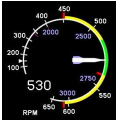
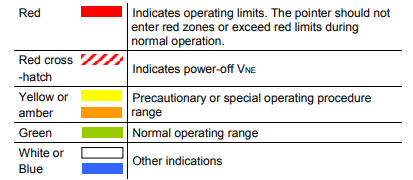
Color-coded instrument markings — the universal language
Every cockpit gauge uses the same visual grammar to surface its limits: green for normal operation, yellow for caution / transient-only, red for never-exceed. Specific values come from certification; the colors mean the same thing across aircraft.
Manifold Pressure / Torque
Engine power output indicator.
- Manifold pressure (piston) — intake manifold absolute pressure, in inches Hg. Higher = more power. Sea level static: typically 28-30 inHg max.
- Torque (turbine) — percentage of maximum continuous torque. Higher = more power.
Both have green / yellow / red arcs. Operating in the green is the goal; brief transient excursions into yellow are usually OK; red is hard limit.
Engine temperature and oil pressure
Continuous monitoring instruments. Any time these leave the green, treat it as a developing emergency.
- Oil temperature — high temp = inadequate cooling, possible oil starvation, or impending failure. Land as soon as practical.
- Oil pressure — low pressure = oil pump failure, oil leak, or cold oil. High pressure = pressure relief valve sticking. Either is a red flag.
- Cylinder head temp (CHT, piston) — high CHT during climb is normal; sustained high CHT in cruise indicates inadequate cooling.
- Turbine gas temp (TGT, turbine) — exceedances cost engine cycles. Brief transients can be tolerated; sustained elevated TGT shortens hot-section life.