Electrical System
Most light helicopters use a 14V or 28V DC electrical system powered by an engine-driven alternator (or generator on older designs), with a battery for engine start and as a backup. The key pilot knowledge: which systems are essential to flight, which are convenient, and which can be shed when the alternator fails. Engine ignition (mags) is independent of the electrical bus on most piston engines — the engine keeps running even with a complete electrical failure.
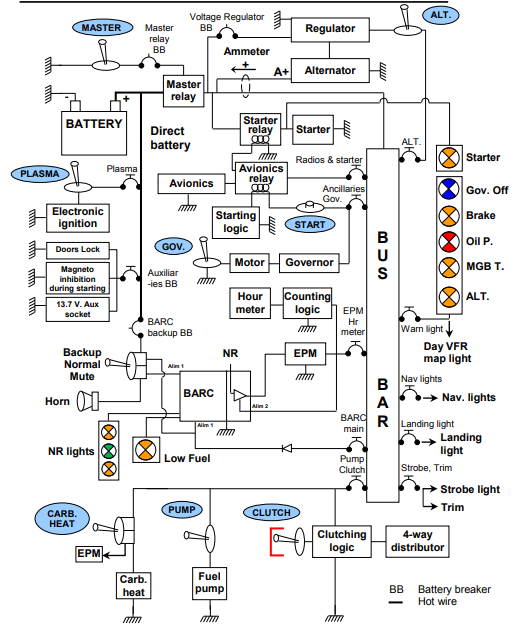
The basic system
- Battery — 12V or 24V depending on system. Provides starting current and emergency backup if the alternator fails. Typical capacity: 15-30 minutes of essential loads after alternator failure.
- Alternator (or generator on older designs) — engine-driven, charges the battery and powers all in-flight electrical loads. Output regulated to bus voltage (typically 14V on a 12V system or 28V on a 24V system).
- Master switch — controls electrical bus power. Off = no electrical loads (engine still runs).
- Voltmeter / ammeter — monitors charging behavior. Voltmeter reads bus voltage; ammeter reads current flow into or out of the battery.
- Circuit breakers / fuses — protect individual circuits from overload.
What's electrical, what isn't
Powered by the bus (need electrical):
- Radios (COM, NAV)
- Transponder
- Strobes, position lights, anti-collision beacon
- Landing light, instrument lighting
- Heater fan / defroster
- Some engine instruments (electric tachometer, EGT/CHT gauges on some helicopters)
- Autopilot (where installed)
- GPS, glass cockpit displays
Independent of the bus (work without electrical):
- Magnetos (ignition on piston engines) — completely independent of the electrical system
- Pitot-static instruments (altimeter, ASI, VSI) — pneumatic, no electrical
- Vacuum-driven gyros (where installed) — engine-driven vacuum pump
- Mechanical engine instruments (oil pressure on a Bourdon-tube gauge, etc.)
- Manual fuel valve, mixture, throttle
Practical implication: a complete electrical failure leaves you with engine power, primary flight instruments, and basic engine indications. You lose comms, transponder, and most secondary equipment.
Failure modes and recognition
- Alternator failure — voltmeter reads battery voltage (~12V on a 14V system) instead of charging voltage (~14V). Ammeter shows discharge. Battery will sustain essential loads for 15-30 minutes; shed non-essential loads to extend.
- Battery failure — alternator can run the bus on its own, but no backup. Land at next reasonable opportunity.
- Complete electrical failure — both gone. Engine still runs. Use mechanical/pitot-static instruments. Squawk 7600 not possible (no transponder); proceed to nearest airport per visual rules.
- Smoke or burning smell — possible electrical fire. Master off, follow POH emergency procedure.
Pre-flight electrical check
- Master switch ON — observe bus voltage rises with engine started.
- Voltmeter shows bus voltage in normal range.
- Ammeter shows positive (battery charging) shortly after start.
- Test radios, transponder, strobes, beacon, landing light.
- Pitot heat test (if equipped) — listen for current draw on ammeter, feel pitot tube get warm.
- Cycle each electrical item briefly to confirm response.