Weight & Balance
Helicopter performance and handling depend critically on weight (how much) and CG (where). Helicopter CG envelopes are notably tighter than fixed-wing — there's less margin for error in loading. Out-of-CG operations don't merely degrade performance; they can produce a flight regime where the cyclic doesn't have enough authority to recover from a maneuver. Always compute weight and balance before flight — particularly with passengers, fuel loads, sling loads, or unusual cargo configurations.
The basic terms
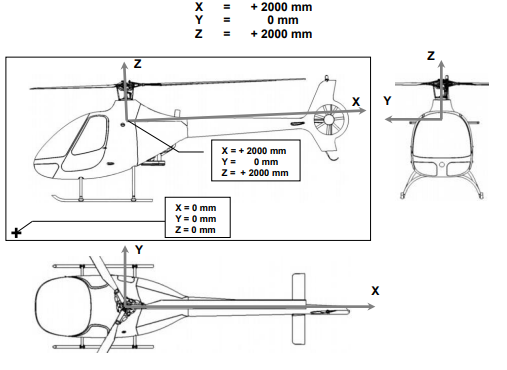
- Datum — an imaginary reference point from which all arms are measured. Specified in the POH; varies by aircraft (often the rotor mast centerline or a forward fuselage reference).
- Arm — horizontal distance from the datum to a component or load. Forward of datum is sometimes negative; aft is positive (or vice versa, per POH convention).
- Moment — weight × arm. Used to compute CG.
- Center of gravity (CG) — the point where total weight effectively acts. Computed by summing all moments and dividing by total weight.
- Basic empty weight — standard helicopter + optional equipment + unusable fuel + full operating fluids (including engine oil).
- Operating empty weight — empty weight + pilot + crew baseline.
- Maximum gross weight — POH limit for total weight. Two flavors: internal max gross (occupants, fuel, baggage) and external max gross (with sling load).
Computing W&B
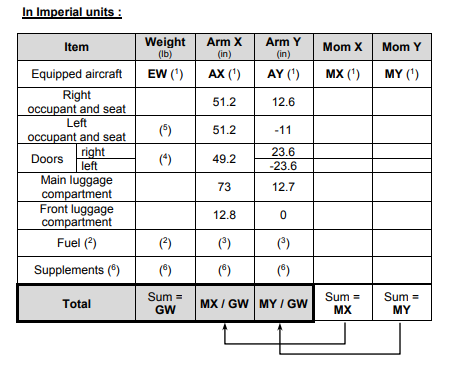
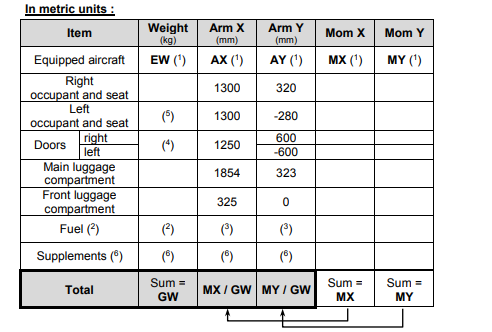
- Look up basic empty weight and arm (or moment) in the aircraft's most recent W&B sheet.
- Add each load (pilot, passenger, fuel, baggage) with its weight and arm. Compute moment for each.
- Sum total weight, sum total moment.
- CG = total moment ÷ total weight.
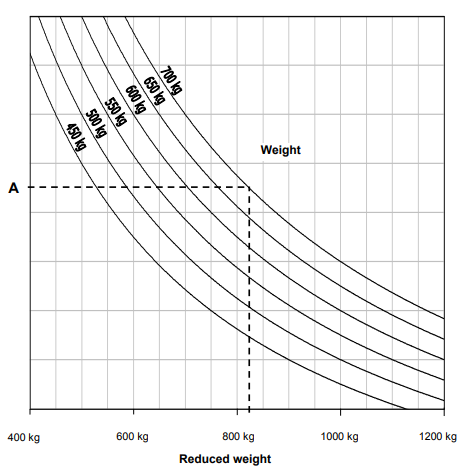
- Compare CG and total weight against the POH envelope chart. Both must be within limits.
Most flight schools provide a tabulated worksheet. Software (like ForeFlight or SkyVector W&B tools) automates this. Either way, the math takes 5 minutes and prevents the kind of mistake that doesn't fix itself in the air.
The longitudinal CG envelope
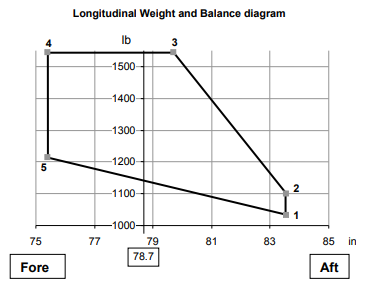
The "envelope" is the region of weight + longitudinal CG combinations within which the aircraft is certified to operate. Outside the envelope, controllability and structural margins are no longer guaranteed.
Lateral CG — the often-forgotten axis
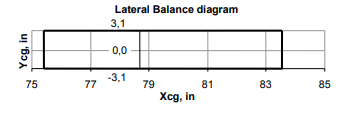
Most fixed-wing W&B focuses entirely on longitudinal CG because the airframe is symmetric and lateral loading is rarely an issue. Helicopters are different: occupants sit side-by-side near the rotor mast, fuel is often a single off-center tank, and side-mounted equipment (door-opening sensors, hoists, external cameras) shifts CG laterally. The lateral CG envelope is just as real as the longitudinal one.
Forward CG — too much weight up front
Loading too far forward (heavy front passenger, light rear passenger, full nose baggage) shifts the CG forward.
- Effects: Helicopter wants to pitch nose-down. Cyclic must be held aft to maintain attitude. In cruise, you may have less aft cyclic remaining than you'd like.
- Risk: May not have enough aft cyclic authority to flare for landing. Excessive landing distance, possible inability to slow down before touchdown.
- Fix: Move some weight aft (rear passenger, baggage repositioned).
Aft CG — too much weight in back
Loading too far aft (heavy rear passenger, light or no front passenger, baggage in the tail compartment) shifts CG aft.
- Effects: Helicopter wants to pitch nose-up. Cyclic must be held forward to maintain attitude. In cruise, you may have less forward cyclic remaining.
- Risk: May not have enough forward cyclic to lower the nose if a gust pitches you up. Risk of tail boom strike at high airspeed.
- Fix: Move some weight forward (front passenger, repositioned baggage).
Aft CG is generally considered more dangerous than forward CG for helicopters because the recovery techniques (forward cyclic) are limited.
Underloading — solo flight ballast
Some helicopters (notably the Robinson R22 and R44) require a minimum weight or forward ballast for solo operations. The reason: an empty front seat shifts CG aft, putting the helicopter near or beyond the aft CG limit.
Without proper ballast, autorotation may not be achievable at desirable rotor RPM — the rotor may not autorotate properly. Robinson POH specifies seat ballast weights for solo flight. Use them.
Effects of overloading
- Longer takeoff and landing distances
- Reduced rate and angle of climb
- Lower service ceiling
- Reduced cruise speed and range (more induced power demanded)
- Decreased maneuverability
- Excessive structural loads — potentially exceeding airframe limits
- Increased risk of retreating blade stall at high airspeed
- Reduced VRS margin during slow flight
Overweight operation is illegal under FAR 91.9 and 91.13. It's also dangerous in proportion to how far over the limit you are. There's no margin past max gross weight.