Translational Lift & ETL
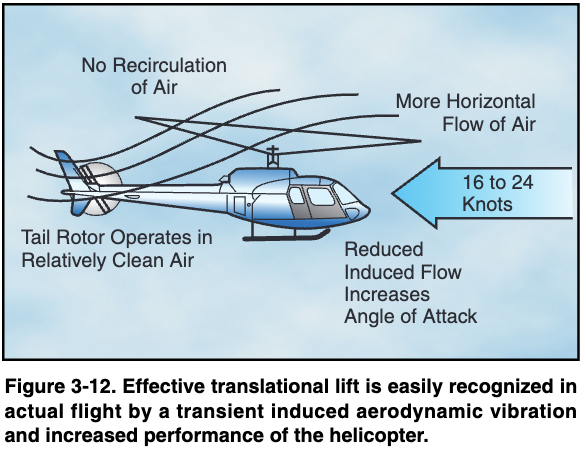
As a helicopter accelerates from a hover into forward flight, the rotor stops recirculating its own downwash and starts working in undisturbed air. Around 16–24 knots that change becomes dramatic — the rotor suddenly produces noticeably more lift for the same collective pitch. That jump is Effective Translational Lift (ETL). A second, paired effect — transverse flow — produces a right roll tendency in the same speed band that you compensate for with left cyclic.
Also called: ETL, translational thrust, "going through ETL"
Why translational lift exists
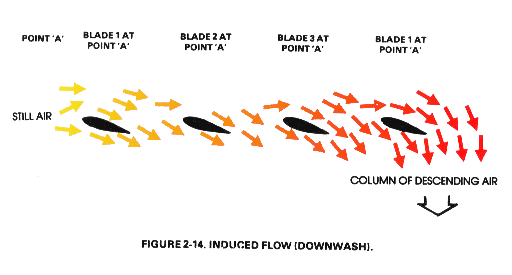
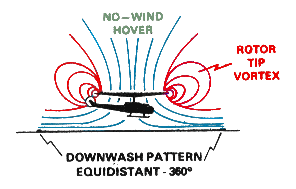
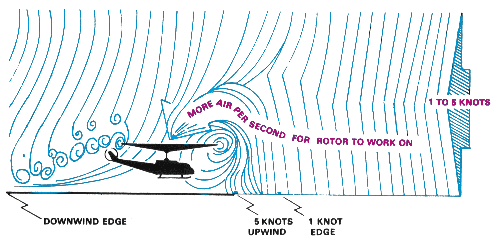
In a hover, the rotor is producing thrust by pushing air down through the disc. That column of accelerated air doesn't disappear — much of it gets pulled back into the disc on the next revolution. The rotor is, in effect, recirculating its own wake. Recirculated air is turbulent, and it's already moving downward — so the rotor blades have to work harder (use more induced power) to extract lift from it.
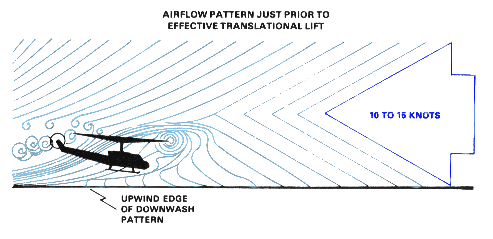
As the helicopter starts moving forward, the rotor begins to fly into clean, undisturbed air. Recirculation drops off. Each blade pass meets fresh air with no downward component, so induced drag falls and the rotor produces more lift for the same pitch and torque. This is translational lift in the literal sense — lift gained from translating through the air.
The ETL transition (16–24 knots)
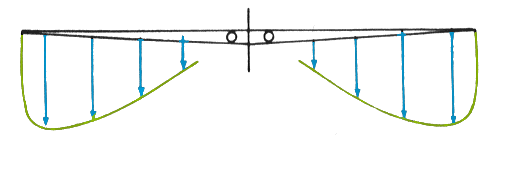
Translational lift increases gradually with speed, but somewhere around 16–24 knots there's a sharp inflection. The recirculation pattern collapses, induced flow through the disc reorganizes, and the rotor's efficiency jumps. You feel three things, in this order:
- A vibration as the disc transitions out of the hover regime — sometimes called "the shudder."
- A nose-up pitching tendency as the increased lift takes effect.
- A climb if you don't compensate.
Pilot inputs through ETL: anticipate slight forward cyclic to hold the attitude and a small collective reduction to hold altitude. On takeoff, ETL is when the helicopter "wants to fly" — your job is to stay coordinated through the transition.
Same thing happens in reverse on a slow approach: as you decelerate through ETL, the rotor loses translational lift, settles, and you need collective and aft cyclic to manage it. A great many bad approaches are bad because the pilot didn't anticipate the loss of ETL coming back through the band.
Transverse flow effect
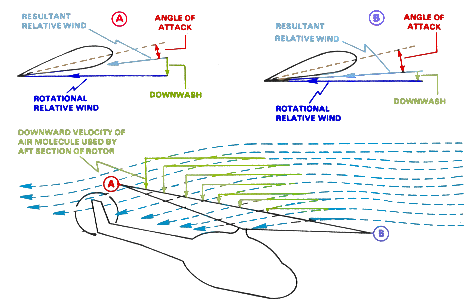
While ETL is changing the amount of lift, a second phenomenon changes the distribution of lift across the rotor disc. As forward speed builds, the front of the disc is meeting clean air with very little induced (downward) component, while the back of the disc is still flying through air that the front of the disc just deflected downward. The result:
- Front of disc — high angle of attack relative to the air it's hitting → blades flap up.
- Back of disc — low angle of attack relative to its already-deflected air → blades flap down.
Because of gyroscopic precession, that flap-up-front / flap-down-back pattern shows up 90° later in the direction of rotation. On a US (CCW from above) rotor system, that means a right rolling tendency appears in the same speed band as ETL — roughly 16–20 knots.
Compensation: a small amount of left cyclic. Most pilots never consciously identify transverse flow as a separate phenomenon — they just feel "the helicopter rolls right going through ETL" and pre-load the cyclic. That instinct is correct; the underlying mechanism is transverse flow plus precession.
Why this matters for the checkride
Translational lift shows up on the PPL knowledge test, the oral, and the practical:
- Knowledge test — expect a question on the speed band where ETL kicks in (16–24 kt range), what causes it, and the direction of the rolling tendency from transverse flow.
- Oral — DPE often asks "what do you feel going through ETL?" — vibration, pitch-up, increased climb rate / lift, lateral roll tendency. Bonus points if you can name transverse flow as the cause of the roll separately from ETL itself.
- Practical — your takeoff and approach quality depend on managing ETL transitions smoothly. A jerky takeoff that climbs through ETL with no anticipation is a clear marker that the pilot doesn't understand what's happening.
Edge cases & gotchas
Out-of-wind hover: ETL also happens when the wind blows through the disc faster than the helicopter is moving. A hover into a 16-knot headwind means you're already getting translational lift benefits. Land into the wind for the same reason.
Confined-area takeoffs: If you can't accelerate through ETL because you have to climb vertically over an obstacle, you don't get the lift bonus and you're fighting recirculation the whole way up. This is why max-performance takeoffs eat power — and why a downwind departure off a confined area is dangerous (you may never reach ETL).
High density altitude: ETL still occurs at the same airspeeds, but the absolute lift produced is lower because the air is thinner. You still get the relative bonus going through ETL; you just don't get as much of it.