Vortex Ring State
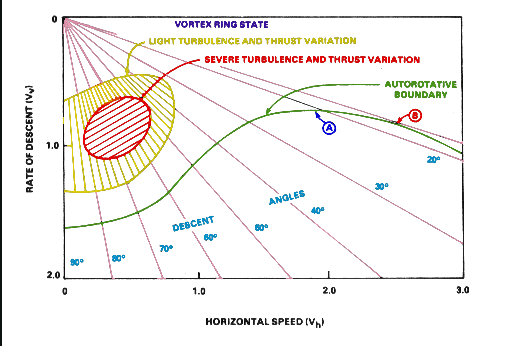
An aerodynamic condition in which a helicopter descends into its own recirculating downwash. The rotor stops finding clean air; lift drops; descent rate increases; pulling collective makes it worse. Three conditions must all be present — powered descent, descent rate ≥ ~300 fpm, and airspeed below ETL. Miss any one and you're not in VRS. The classic recovery costs altitude; the Vuichard technique can recover with much less.
Also called: VRS, settling with power, "the rotor falling into itself"
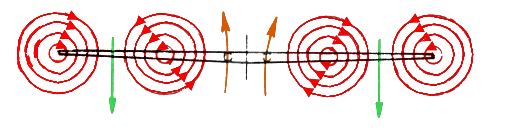
The three conditions
Every helicopter handbook writes them slightly differently; the substance is identical. All three must be present at the same time:
- Powered descent — typically 20–100% power applied. You are not in autorotation. The rotor is producing thrust downward and the helicopter is sinking into that thrust.
- Rate of descent at or above approximately 300 fpm — fast enough that the rotor's downwash starts to recirculate back through the disc.
- Airspeed below ETL (typically under ~16 knots in still air) — slow enough that you're not flying out of your own column of disturbed air.
If you're descending at 300 fpm but airspeed is 60 kt, you're not in VRS — you're in a normal descent. If you're slow but climbing, you're not in VRS. If you're hovering with no descent, you're not in VRS. Take any single condition out and the regime is different.
What it feels like
VRS announces itself with three coupled signals:
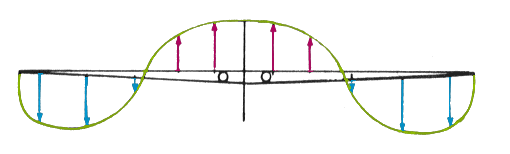
- Low-frequency vibration — the recirculating tip vortices striking the rotor disc. Sometimes described as a rumble or a "buzz" through the controls.
- Increased descent rate that doesn't respond to collective — this is the diagnostic. In a normal sink, pulling collective slows the descent. In VRS, pulling collective worsens the recirculation and increases descent rate.
- Pitch and roll instability — the disc isn't producing lift evenly; the helicopter wants to wobble. New students sometimes mistake this for control input problems.
The "doesn't respond to collective" cue is the one to internalize. Any time you pull collective and the helicopter doesn't climb (or descends faster), assume VRS until proven otherwise. Don't pull more.
Classic recovery — push forward, lower collective
The textbook recovery, applicable to any helicopter:
- Lower collective slightly to stop adding to the recirculating downwash.
- Forward cyclic to gain airspeed and fly out of the disturbed-air column.
- As airspeed builds through ETL, the rotor finds clean air, lift returns, and you can recover with collective.
Cost: typically 100–500 ft of altitude depending on aircraft and entry severity. If you noticed VRS on a low approach, the classic recovery may put you in the trees.
Vuichard recovery — lateral exit
Claude Vuichard's technique trades altitude loss for a brief lateral acceleration. The aircraft slides out of its own disturbed air column instead of flying out of it. For a US helicopter (CCW main rotor):
- Raise collective to maximum continuous power.
- Right cyclic — about 10–20° of lateral bank.
- Left pedal as needed to maintain heading against the increased torque.
The aircraft slides sideways at 1–3 seconds and exits the recirculating column. Reported altitude loss is often under 50 ft — an order of magnitude better than the classic recovery.
Caveat: Vuichard requires retraining. Direction of inputs reverses for CCW vs CW rotors. The ACS still expects the classic technique because it's universally applicable. Knowing both — classic for the checkride, Vuichard for low-altitude entries — is the responsible position.
How you actually get into it
Almost always one of three setups:
- Downwind approach — you bleed off groundspeed faster than airspeed. By the time the LZ is in sight you're slow and high.
- Steep approach — you let descent rate build past 300 fpm without enough airspeed margin.
- High hover OGE in a confined area — wind shifts, you lose ETL, descent starts as you try to hold position with collective.
The common thread: you stopped flying through the air and started falling through it. VRS is the aerodynamic consequence of that flight regime; it is not a malfunction.