Ground Effect
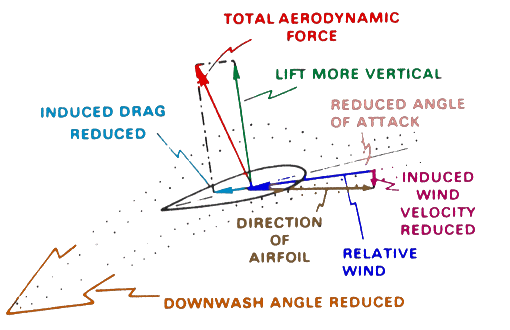
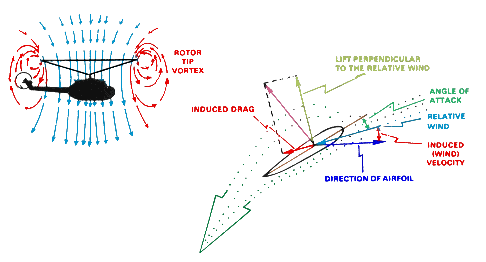
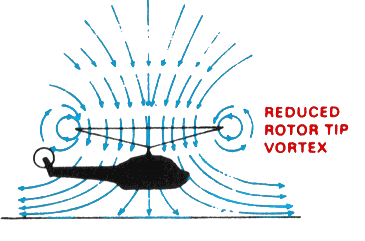
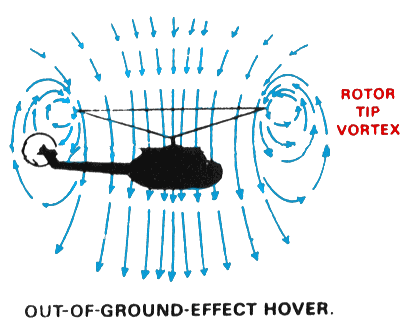
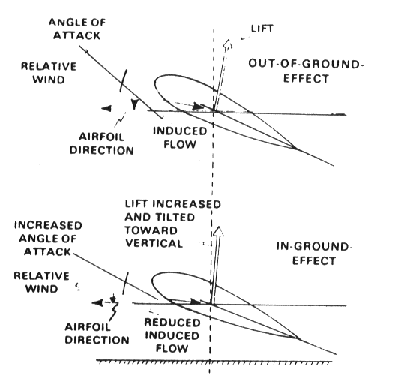
When the rotor disc is within roughly one rotor diameter of the surface, the ground physically blocks the downwash from circulating back into the rotor. Induced flow drops; induced drag drops; the rotor produces lift more efficiently. In Ground Effect (IGE) hovering takes less power than Out of Ground Effect (OGE) hovering by 10–20% depending on aircraft. Whether your destination is OGE or IGE-capable is a go/no-go question every helicopter pilot answers before every approach.
Also called: IGE / OGE, "the cushion"
The mechanism
In a hover, the rotor pushes a column of air down through the disc. Out of ground effect, that downwash recirculates — much of it curls back up around the disc edges and gets pulled in again on the next revolution. The rotor is effectively flying through air that already has downward motion, which means each blade has to work harder (with higher induced angle of attack, hence higher induced drag) to extract lift.
Close to the ground, the surface deflects the downwash outward instead of letting it curl back up. Recirculation drops sharply. The rotor sees cleaner air, induced drag falls, and the same collective produces more usable lift. You get a free efficiency boost — the "ground cushion" pilots talk about.
How close is "close enough"?
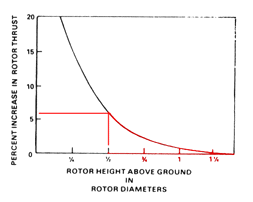
The textbook number is approximately one rotor diameter above the surface. For a Robinson R22 (rotor diameter ~25 ft), full ground effect is gone by about 25 ft skid height. For a larger Bell 206 (rotor diameter ~33 ft), it persists higher.
The effect doesn't switch off cleanly — it tapers. At ½ rotor diameter, IGE is nearly full strength. At 1 diameter, it's mostly gone. At 2 diameters, you're functionally OGE.
Two things that erode IGE even when you're physically close to the surface:
- Sloped or rough terrain — irregular surface lets some downwash escape downward instead of being deflected outward.
- Tall grass, water, snow — soft surfaces absorb or redirect downwash. Pilots flying over water or vegetation often note diminished IGE compared to hard runways at the same skid height.
IGE vs OGE in the POH
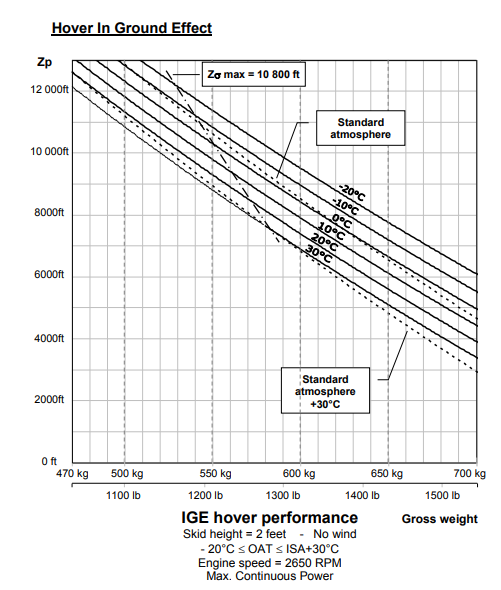
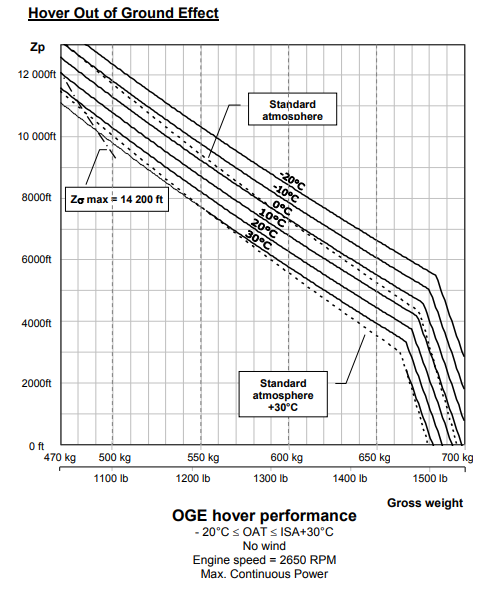
Every helicopter POH publishes two hover charts: one for IGE, one for OGE. The IGE chart will show a higher max gross weight at any given pressure altitude and temperature. The OGE chart is the limiting one for most operational planning.
The discipline: when you're computing whether you can land somewhere, the relevant question is "can I hover OGE at the approach to that LZ?" Not whether you can sit IGE on the LZ once you're there. You arrive OGE during the approach, and you may have to abort to OGE if you mis-judge the touchdown — if OGE is unavailable, you have no escape route.
Confined-area operations and pinnacle landings are essentially OGE planning exercises. Ground effect over a pinnacle landing pad is reduced anyway (the pad is small, downwash spills over the edges) and you can't count on the cushion.
Real chart: Cabri G2 hover capability
What the previous chart looks like in an actual POH. The Cabri G2 RFM publishes IGE and OGE hover charts that you read before every high-DA flight to verify you can operate at your planned gross weight.
Why IGE matters operationally
Takeoffs: a hover-in-ground-effect check is part of every takeoff. If you can't hover IGE at this weight in this DA, you can't depart — period. The hover check is the last opportunity to abort before committing to translational flight.
Power checks: what collective position you need to hover IGE at known weight and DA tells you the power available. Pilots flying high-DA mission profiles develop a feel for "how much collective is normal" and a dry power check is a critical skill.
Confined area work: when departing a tight LZ, you may not have room to translate to ETL while still in ground effect. You're punching out of IGE into OGE before reaching ETL — the most demanding power configuration the helicopter sees. Plan to depart with margin or don't depart.
Sloped landings: as you set down on a slope, the upslope skid touches first and the rotor disc tilts. Ground effect distribution becomes asymmetric, and the helicopter wants to slide downslope. This is why sloped landings demand light collective application and disciplined cyclic.